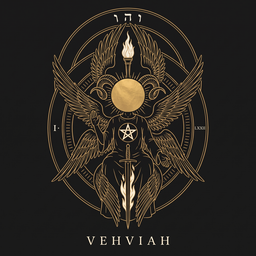
 Ars Occulta
 / Ars Goetia / Viné
45 / 72
Viné
Vine, Vinea
- Rank
- King
- Planet
- ☉Sun
- Legions
- 36

No settled etymology exists for this name, though the entry compensates with a trait almost no other has: a double title. He is at once Great King and Earl, with thirty-six legions. The kingship ties him to the Sun and grants him command over other spirits, the grimoire's highest rung; the earldom adds the martial register of Mars. His usefulness is broad: he discovers witches and hidden things, answers on things past, present and to come, builds towers, throws down stone walls and stirs up tempests. The operator calls him as readily to know as to destroy. He arrives as a lion on a black horse, a viper in his hand.
What he was asked for
Two of his offices were ordinary service in the England of the period: to discover what is hidden and to discover witches. The second sounds quaint today and was not then. When a man's cattle died or his child fell ill, what he wanted was not a generic punishment but a name: who did it. That is what the English village magicians, the cunning folk, lived on, and it is exactly the demand Vine answers.
No document records anyone summoning him by name. What is documented is the demand his entry describes.
What the picture means
He arrives as a lion riding a black horse, a viper in his hand. The lion did not simply mean ferocity. Isidore of Seville, whose encyclopaedia was still being copied and quoted in 1600, writes that the word lion translates as «king», that it sleeps with its eyes open and that it sweeps away its own tracks with its tail. Pliny adds that it is the only wild animal that spares whoever lies down before it. So: royalty, vigilance, and a trail that cannot be followed.
The viper is more specific than it looks. In Pliny and in Isidore, the female viper tears off the male's head while mating, and the young are born bursting through their mother's sides. It is not the venom that is being represented: it is parricide. A king who leaves no trace, holding the animal that kills its own parents.
Where the sources disagree
There is a large and little-known difference here. In Weyer's catalogue of 1577, and in its English translation of 1584, Vine divines nothing and discovers no witches. His whole entry is building work and weather: he gladly builds great towers, throws down stone walls, and makes waters rough. The entire block of divination and witch-finding is added by the Lemegeton, copied later.
The legions do not match either: thirty-six in Mathers' 1904 edition, thirty-five in the transcription of the Sloane 2731 manuscript, and no figure at all in Weyer.
On the name there is a proposal that fits too well to leave out: vinea was, in Latin, the siege engine — a timber shed, hide-covered, pushed up to the foot of the wall to mine it. A spirit called «siege engine» whose office is to raise towers and throw down walls. The derivation is a modern scholarly proposal, not a datum of the manuscript, but the machine existed and is well documented.
Sources
- Lemegeton Clavicula Salomonis · Ars Goetia — ms. Sloane 2731 y edición Mathers, 1904
- Johann Weyer, Pseudomonarchia Daemonum, 1577
- Reginald Scot, The Discoverie of Witchcraft, 1584
- Plinio el Viejo, Naturalis Historia, siglo I — león y víbora
- Isidoro de Sevilla, Etymologiae, siglo VII — león y víbora
- Owen Davies, Popular Magic: Cunning-folk in English History
Other kings of the Goetia
The hyperrealistic reconstruction of Viné and those of the other 143 entities are published on Instagram as they are completed. See Viné on Instagram →
WarningHistorical and artistic content. We do not recommend performing any ritual, invocation or practice involving these entities. This is outreach about texts from the 15th to the 20th century, not an operative guide.