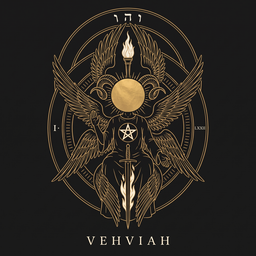
 Ars Occulta
 / Ars Goetia / Asmoday
32 / 72
Asmoday
Asmodai, Sydonay
- Rank
- King
- Planet
- ☉Sun
- Legions
- 72

Asmoday is Asmodeus, the demon of the Book of Tobit, where he obstructs Sarah's marriages; later demonology inherits him from there, and some scholars propose in addition a link with the Iranian Aeshma daeva, a disputed hypothesis. The manuscript makes him a Great, Strong and Powerful King, a solar grade, with seventy-two legions, the maximum in the catalogue. He was asked for the ring of virtues, for arithmetic, astronomy and geometry, for invisibility and for the location of guarded treasure. The warning is a matter of protocol: the operator must uncover his head and remain standing before him, since otherwise Amaymon will deceive him.
Where he actually comes from
One of the few in the catalogue with a genealogy you can follow. The oldest root proposed is Iranian: aēshma, «wrath, fury», plus daēva, «demon». It should be said honestly: that exact compound does not appear in the surviving Avestan texts, it is reconstructed from a later Pahlavi form. From there it passes into the Hebrew Ashmedai of the Talmudic tradition, and into the Greek Asmodaios of the book of Tobit.
In Tobit there is no rank, no legions, no three heads. There is a demon who has killed seven of Sarah's husbands on the wedding night, and a practical way to be rid of him: burn the liver and heart of a fish, because the smoke drives him off. The archangel Raphael binds him in Egypt and that is the end of it. In the Testament of Solomon, three centuries later, he turns up in forced labour on the building of the Temple, and hating water.
Fifteen hundred years later the grimoire makes him a great king with seventy-two legions, the highest figure on the list. From the demon of a domestic story to a general of armies.
What he was asked for
Three things: where treasure lies buried, becoming invulnerable, and mathematics. The first is written into the law again: the 1542 act punishes conjuring spirits to «find money or treasure». Treasure hunting with the help of spirits was a widespread and prosecuted practice across Europe.
The mathematics are not abstract either. Arithmetic and geometry in that period mean surveying land, raising fortifications and aiming artillery. And «made invincible» is a soldier's request.
The entry itself carries protocol, not ornament: whoever summons him must stand the whole time with his head uncovered, or the spirit will deceive him.
Where the sources disagree
There is a one-letter difference with consequences. Mathers' edition, of 1904, says he makes men invincible. The Sloane 2731 manuscript and Weyer say he makes them invisible. Almost everything published today repeats Mathers.
In Weyer the principal name is not even Asmoday, it is Sydonay, with Asmoday as an alias. The rank and the seventy-two legions do agree.
His picture was remade too. The manuscript gives him webbed goose feet and sits him on an infernal dragon. The Dictionnaire Infernal of 1818 removes both: it gives him a cock's leg and mounts him on a lion with wings and a dragon's neck. That second version is the one almost everybody knows.
On the ram's head there is a period link that does hold: the Malleus Maleficarum of 1486 classes Asmodeus as the demon of lust.
Sources
- Lemegeton Clavicula Salomonis · Ars Goetia — ms. Sloane 2731 y edición Mathers, 1904
- Johann Weyer, Pseudomonarchia Daemonum, 1577 — «Sydonay, alias Asmoday»
- Libro de Tobías, deuterocanónico, siglos III-II a.C.
- Testamento de Salomón, siglos I-III d.C.
- Malleus Maleficarum, 1486
- Witchcraft Act, 1542 (33 Hen. VIII c. 8)
- Collin de Plancy, Dictionnaire Infernal, 1818
- Johannes Dillinger, Magical Treasure Hunting in Europe and North America, 2012
Other kings of the Goetia
The hyperrealistic reconstruction of Asmoday and those of the other 143 entities are published on Instagram as they are completed. See Asmoday on Instagram →
WarningHistorical and artistic content. We do not recommend performing any ritual, invocation or practice involving these entities. This is outreach about texts from the 15th to the 20th century, not an operative guide.