 Ars Occulta
 / Ars Goetia / Andras
63 / 72
Andras
—
- Rank
- Marquis
- Planet
- ☽Moon
- Legions
- 30

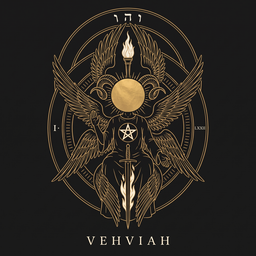
An angel with the head of a black raven, riding a wolf, sword raised. Andras records no alternative spellings and no identifiable antecedent, and the text grants him no nuance: his function is to sow discord. He is a Marquis, a grade the grimoire's planetary scheme assigns to the Moon, with thirty legions. Here the operative warning is harsher than almost anywhere else in the catalogue: if the conjurer is not on his guard, Andras will kill him and his companions. No knowledge, treasure or favour is attributed to him; he is called only to break agreements, alliances and friendships among third parties.
The only entry that warns it can kill you
The whole catalogue reads as an inventory of services. Andras' entry is the exception: it says that if the exorcist is not careful, he will slay both him and his fellows.
And the sentence changed meaning between versions. Weyer, in 1577, states it as a capacity, unconditionally: he can kill the master, the servant and all the assistants. The Lemegeton, copied later, rewrites it as a safety warning: «if the exorcist have not a care». From statement to caution.
The victims drop from three to two along the way. Weyer lists master, servant and assistants; the Lemegeton leaves the operator and his fellows. And the seal, according to the Sloane manuscript, is to be worn as a lamen on the breast — defensive protocol, not decoration.
The wolf and the night bird
He rides a black wolf, and the wolf was not a neutral animal in 1600. Isidore of Seville and Pliny repeat the same belief: the man the wolf sees first loses his voice. The Aberdeen Bestiary, from around 1200, reads it straight as the Devil: its eyes shine at night like lamps because the works of the Devil seem beautiful to the blind and the foolish, and it cannot turn its neck without turning its whole body, just as the Devil never turns toward repentance.
The angel's head is, once again, a nycticorax: the night bird that flees the light, according to Isidore, which Pliny calls a funereal bird and a very bad omen. The same word that confused the copyists of Stolas.
The raised sword is «sharp» in Weyer and in Scot; the Lemegeton adds that it is bright as well.
What does agree
The thirty legions and the rank of great marquis are the same in Weyer, in Scot and in the Lemegeton. It is one of the steadiest entries in the catalogue: the modern editor records not a single variant of name or figure across the manuscripts.
The only thing that moved is the emphasis. Weyer closes the entry by saying he is the author of discords; the Lemegeton opens with it, and makes it his principal office.
Of the name there is no documented etymology. The proposals in circulation — from the Greek for «man», or from the Zoroastrian demon Andar — have no backing in any critical edition.
Sources
- Lemegeton Clavicula Salomonis · Ars Goetia — ms. Sloane 2731, ed. Peterson; Mathers, 1904
- Johann Weyer, Pseudomonarchia Daemonum, 1577 — «capite nycticoraci nigro simili»
- Reginald Scot, The Discoverie of Witchcraft, 1584
- Isidoro de Sevilla, Etymologiae XII.2.23-24 y XII.7 — el lobo y el ave nocturna
- Plinio el Viejo, Naturalis Historia VIII.34 y X.16
- Bestiario de Aberdeen, c. 1200
Other marquises of the Goetia
The hyperrealistic reconstruction of Andras and those of the other 143 entities are published on Instagram as they are completed. See Andras on Instagram →
WarningHistorical and artistic content. We do not recommend performing any ritual, invocation or practice involving these entities. This is outreach about texts from the 15th to the 20th century, not an operative guide.