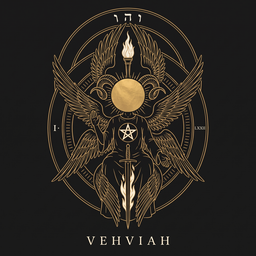
 Ars Occulta
 / Ars Goetia / Andromalius
72 / 72
Andromalius
Andromalious
- Rank
- Earl
- Planet
- ♂Mars
- Legions
- 36

Closing the catalogue is Andromalius, a man holding a great serpent in his hand. The form Andromalious is attested in the copies; the name has a Greek ring to it, but no antecedent can be asserted. He is an Earl, a grade the text's planetary scheme links to Mars, and he commands thirty-six legions. His function is more judicial than magical: he returns the thief and the stolen goods, discovers wickedness and hidden dealings, punishes thieves and reveals hidden treasure. That the list should end with a spirit devoted to restoring what was taken gives the whole a closure of restitution.
A spirit that was actually used
Andromalius closes the catalogue, and he is one of the few known to have been used outside it. The modern editor of the Goetia notes it: he often appears in standalone spells within magic manuscripts, employed for detecting a thief or discovering treasure.
That sets him apart. Most of the seventy-two exist only as entries in a list. Andromalius existed as a tool: somebody wrote him out on a separate sheet because something had gone missing.
His office is exactly that: to bring back both the thief and the goods stolen, to discover all wickedness and underhand dealing, to discover treasures that are hid. And one more thing, rarely mentioned: to punish thieves and other wicked people. He does not only recover; he also collects.
Why that was a crime
Recovering stolen goods was the commonest commission in practical magic, which is why Parliament named it. The English act of 1542 punishes conjuring spirits to «tell or declare where goods stolen or lost shall become».
In a society with no police, no insurance and no register of property, theft was the everyday emergency and there was nobody to turn to. Asking Andromalius who robbed you was, literally, the offence the statute describes.
He holds a serpent in his hand, and here it is best to be honest: no period source explains that attribute. The readings in circulation — the prudence of the serpent, Asclepius, the rod of Moses — are genuine commonplaces of the period, but nobody ever connected them with this spirit.
That is not even his name
The usual name in the manuscripts is not Andromalius but Andromalcus, with many variants: Andromalce, Andromalcum, Andrewemalcus, Andrea Malchus. The Goetia fixed a minority form, and that is the one that stuck.
He is not in Weyer or in Scot either. He is one of the four the Lemegeton added to Weyer's sixty-nine, along with Vassago, Seere and Dantalion; the same text dropped Pruflas, and that is how the seventy-two of the title were reached.
The consequence: since no earlier version exists, there is nothing to contradict. Thirty-six legions and the rank of earl, and that is all. The only difference between copies is one of size: the manuscripts say «a serpent», and Mathers, in 1904, enlarges it to «a great serpent».
Sources
- Lemegeton Clavicula Salomonis · Ars Goetia — ms. Sloane, ed. Peterson; Mathers, 1904
- Joseph H. Peterson, notas de edición — «Andromalcus» y su uso en conjuros sueltos
- Johann Weyer, Pseudomonarchia Daemonum, 1577 — sin Andromalius
- Witchcraft Act, 1542 (33 Hen. VIII c. 8)
Other earls of the Goetia
The hyperrealistic reconstruction of Andromalius and those of the other 143 entities are published on Instagram as they are completed. See Andromalius on Instagram →
WarningHistorical and artistic content. We do not recommend performing any ritual, invocation or practice involving these entities. This is outreach about texts from the 15th to the 20th century, not an operative guide.