 Ars Occulta
 / Ars Goetia / Furfur
34 / 72
Furfur
Furtur
- Rank
- Earl
- Planet
- ♂Mars
- Legions
- 26

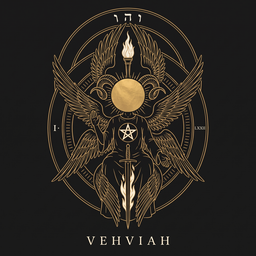
Although his name coincides with an ordinary Latin word, there is no evidence that Furfur derives from it, and the text offers no antecedent at all. The grimoire makes him a Great and Mighty Earl, a martial grade, with twenty-six legions. He was invoked to procure love between man and woman, to unleash tempests, thunder and lightning, and to be questioned about secret and divine things. He carries the clearest operative warning of this stretch: he appears as a hart with a flaming tail and does not speak the truth unless he is forced into the triangle, where he takes the form of an angel and speaks with a hoarse voice.
He lies until you get him into the triangle
His entry carries a clause almost no other has: he never speaks truth, unless he is compelled inside a triangle. Forced there, and if commanded, he takes the form of an angel and answers truly about secret and divine things.
The interesting thing is the date. That condition is already in Weyer, in 1577: in omnibus mentitur, nisi in triangulum introducatur. Which means coercion by triangle exists half a century before the drawn triangles of the Lemegeton. It is not an invention of the seventeenth-century English manuscripts: it came with the text.
The basis of the clause is doctrinal. In the gospel of John the devil is called the father of lies. A catalogue that promises true answers has to explain why, and the triangle is that explanation: he is not believed, he is compelled.
Storms were a crime with a case file
He raises thunder, lightning, blasts and great tempests. That was not a literary image in 1600: it was an accusation with real trials behind it.
The reference case is North Berwick, in Scotland, between 1590 and 1591. Agnes Sampson confessed to raising the storm against James VI's ship on his return from Denmark, by sinking off Leith a dead cat with parts of a corpse bound to it. The king himself later stated that he had met «a contrary wind to the rest of ships». The inquisitors' standard treatise, the Malleus Maleficarum of 1486, devotes a whole chapter to the subject: how they raise hailstorms and tempests.
His other request is domestic and runs the same way: he willingly reconciles love between husband and wife. It was the counterpart of ligature, the spell believed able to prevent a marriage.
The hart has no wings
He is usually drawn as a winged stag, and that is in no period source. The Lemegeton, Weyer and Scot all say the same and no more: a hart with a fiery tail. The wings are a modern addition.
The hart did carry meanings. Isidore and Pliny report that it draws serpents out of their holes with its breath and cures itself by eating them, that it is extraordinarily long-lived, and that it is drawn in by the sound of a pipe. The fiery tail, by contrast, has no gloss: no period source explains why he wears it.
The twenty-six legions and the rank of earl agree in Weyer, in Scot and in the Lemegeton. In the Livre des Esperitz he is a prince. The spelling wavers: Furfur in Weyer, Furtur in the Sloane 3825 manuscript. And of the name there is no etymology: furfur in Latin means «bran», but no period source connects the two.
Sources
- Lemegeton Clavicula Salomonis · Ars Goetia — ms. Sloane 3825, ed. Peterson; Mathers, 1904
- Johann Weyer, Pseudomonarchia Daemonum, 1577 — «in omnibus mentitur, nisi in triangulum introducatur»
- Reginald Scot, The Discoverie of Witchcraft, 1584
- Procesos de North Berwick, Escocia, 1590-1591 — confesión de Agnes Sampson
- Malleus Maleficarum, 1486 — capítulo sobre granizadas y tempestades
- Isidoro de Sevilla, Etymologiae XII.1.18 · Plinio el Viejo, Naturalis Historia VIII.41 y 50 — el ciervo
- Evangelio de Juan 8:44
Other earls of the Goetia
The hyperrealistic reconstruction of Furfur and those of the other 143 entities are published on Instagram as they are completed. See Furfur on Instagram →
WarningHistorical and artistic content. We do not recommend performing any ritual, invocation or practice involving these entities. This is outreach about texts from the 15th to the 20th century, not an operative guide.