 Ars Occulta
 / Ars Goetia / Bael
01 / 72
Bael
Baal, Baël, Buel
- Rank
- King
- Planet
- ☉Sun
- Legions
- 66

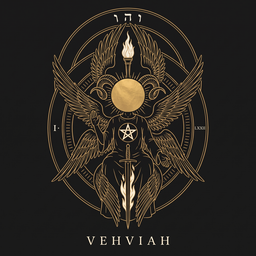
The name derives from Baal, a Northwest Semitic title meaning "lord" that was applied to Canaanite deities such as Hadad; Christian demonology turned that rival god into the first spirit of the catalogue. The manuscript presents him as a King, a solar rank implying command over other spirits, with 66 legions under his authority. He was summoned for one very specific purpose: to make the operator invisible, who had to carry his seal to secure obedience. The text warns that he speaks in a hoarse voice and shifts shape without transition: toad, cat, and crowned man. The nineteenth-century printed engraving fixed his best-known version, with three heads on spider's legs.
What he was asked for
The manuscript gives him a single power: he makes the one who summons him invisible. One, and nothing else. That is not an oddity of the text — invisibility was one of the standing requests of the trade. The Munich Manual, a fifteenth-century magic notebook held in the Bavarian State Library, contains experiments for becoming invisible alongside others for acquiring money, obtaining love and divining the future. It was part of the practical catalogue, not a stray fantasy.
In Johann Weyer's version, from 1577, he also makes the summoner wise. The Lemegeton drops that second half and leaves only the invisibility.
Why a toad and a cat
Weyer describes him with three heads at once: toad, man and cat. The Lemegeton changes that sentence and says he shifts shape — toad, cat, crowned man — without claiming he wears them together. The image of three heads on one body, which is the one almost everybody knows, comes from the 1863 engraving in the Dictionnaire Infernal.
The two animals are not decoration. In the England of 1600 the toad and the cat were the creatures that turned up most often in witchcraft trials as «familiars»: the body the household demon took. A study of the English trials published in the journal Religions counts roughly three in four accusations mentioning one of them, and the 1604 Witchcraft Act went as far as punishing anyone who would «feed or reward any evil and wicked spirit». The toad, besides, was pure poison: Edward Topsell's natural history of 1608 declares every toad venomous, of the earth and of the water alike.
No manuscript explains why Bael carries those two animals. But a reader of the period needed no explanation: the first spirit on the list turned up wearing the two faces of the demon that lived in the kitchen.
Where the sources disagree
The legions move a great deal. Six in the Livre des Esperitz, the oldest witness, French, from the fifteenth or sixteenth century. Sixty-six in Weyer and in the Lemegeton. Two hundred and fifty in the Sloane MS 3824. Between the first and the last there is a factor of forty.
The rank does not hold either: king in Weyer and in the Goetia, prince in the Grimoire of Pope Honorius. And in the Liber Officiorum Spirituum, an earlier branch of the same tradition, there are no animals at all: he appears as a hoarse-voiced king, or sometimes a soldier, and his powers include the sciences and love.
Sources
- Lemegeton Clavicula Salomonis · Ars Goetia — manuscritos del siglo XVII (ed. Mathers y Crowley, 1904)
- Johann Weyer, Pseudomonarchia Daemonum, 1577
- Reginald Scot, The Discoverie of Witchcraft, 1584 — traducción inglesa del texto de Weyer
- Edward Topsell, The Historie of Serpents, 1608
- Helen Parish, «Witches, Familiars, and Human-Animal Interactions in the English Witch Trials», Religions 10:2, 2019
- Richard Kieckhefer, Forbidden Rites, 1998 — edición del Manual de Múnich (CLM 849)
- Witchcraft Act, 1604 (1 Ja. I c. 12)
Other kings of the Goetia
The hyperrealistic reconstruction of Bael and those of the other 143 entities are published on Instagram as they are completed. See Bael on Instagram →
WarningHistorical and artistic content. We do not recommend performing any ritual, invocation or practice involving these entities. This is outreach about texts from the 15th to the 20th century, not an operative guide.