 Ars Occulta
 / Ars Goetia / Vassago
03 / 72
Vassago
Usagoo, Uasago
- Rank
- Prince
- Planet
- ♃Jupiter
- Legions
- 26

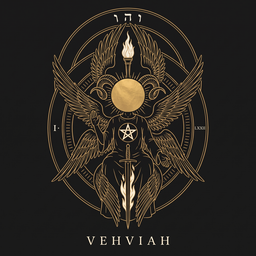
Third in the order, and one of the few the manuscript describes as good-natured: he shares substance with Agares but is, it says, benevolent. No clear historical antecedent is known, and the text gives him no body either; the faceless hooded figure is the contribution of later illustrators. As a Mighty Prince he holds a Jovian rank, high though below the kings, with 26 legions. He was sought for pure divination: to declare things past and things to come, to locate lost objects and to bring to light what someone is hiding. In operative practice, he is the spirit of interrogation.
What the manuscript does not say
With Vassago the striking thing is the gap. The Lemegeton does not describe how he looks. Not a word: no body, no animal, no face. It gives the rank, the twenty-six legions, the office, and stops. He is one of the few on the list with no picture, which is why he is not illustrated in the old editions: there was nothing to draw. The faceless hooded figure that circulates today is a modern invention.
He is not in Johann Weyer's catalogue of 1577 either, the oldest surviving list, which only reaches sixty-nine spirits. Vassago is one of the four added later, along with Seere, Dantalion and Andromalius. The count works out because the Lemegeton also dropped one Weyer did have, Pruflas: sixty-nine, minus one, plus four. He does not come from the tradition: he arrived late.
What he was asked for
His office is two things: to declare what is past and what is to come, and to bring to light whatever is hidden or lost. The second part was the useful one. In an economy with no police and no insurance, theft was the everyday emergency, and magic for recovering stolen goods and naming the thief is documented across Europe: an English formula of the eleventh century written out and tucked into a shoe, a German ritual of 1449 with heated pebbles buried under the threshold, a fourteenth-century Danish charm carved into the lintel to protect livestock.
Vassago is the specialist of that demand. Not the spirit of abstract knowledge: the spirit of knowing who took what.
Where the sources disagree
In the Liber Officiorum Spirituum, an earlier branch of the same tradition, he appears with the name deformed — Usagoo, Vsagoo, Vsago — commands twenty spirits instead of twenty-six, and his powers are different: the love of women and hidden treasure. That is not a change of detail, it is a different profile.
That same text does give him a form, and it is the opposite of what one would expect: he presents himself as an angel, «just and true in all his doings». The only old description of him that exists does not paint him as a monster.
Sources
- Lemegeton Clavicula Salomonis · Ars Goetia — manuscritos del siglo XVII (ed. Mathers y Crowley, 1904)
- Johann Weyer, Pseudomonarchia Daemonum, 1577 — lista de 69 espíritus, sin Vassago
- Liber Officiorum Spirituum · Sloane MS 3824, siglos XVI-XVII
- Chiara Benati, «Charms for Catching and Punishing Thieves in the Medieval and Early Modern Germanic Tradition», en Magic and Magicians in the Middle Ages and the Early Modern Time
- Richard Kieckhefer, Forbidden Rites, 1998 — edición del Manual de Múnich (CLM 849)
Other princes of the Goetia
The hyperrealistic reconstruction of Vassago and those of the other 143 entities are published on Instagram as they are completed. See Vassago on Instagram →
WarningHistorical and artistic content. We do not recommend performing any ritual, invocation or practice involving these entities. This is outreach about texts from the 15th to the 20th century, not an operative guide.