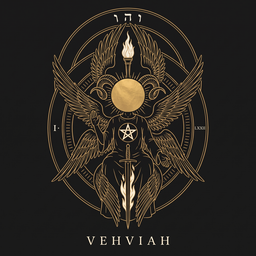
 Ars Occulta
 / Shem HaMephorash / Sitael
03 / 72
Sitael
«God the hope of every creature»
- Choir
- Seraphim
- Archangel
- Metatrón
- Dates
- 31 mar – 4 abr

A name composed of three letters of the Shem HaMephorash and the suffix -EL, which in the kabbalistic tradition denotes the power of God rather than his clemency; it reads "God, the hope of every creature." Its choir is that of the Seraphim, those who burn before the throne in the hierarchy of Pseudo-Dionysius, with Metatron as regent, from 31 March to 4 April. It is invoked in declared adversity, against ruin and slander. Facing it stands Vassago, the prince who declares the past and finds what is lost: foreknowledge against shelter.
How you get 72 names out of three sentences
The three verses that describe the parting of the Red Sea — Exodus 14, verses 19, 20 and 21 — have exactly seventy-two letters each. Three in a row, the same count. Kabbalists took that for a code and not for a coincidence.
The method is this: stack the three lines and read them the way an ox ploughs, out, back, and out again. That gives seventy-two columns of three letters. Sitael is the third: samekh, yod, tet.
The Talmud speaks of a «name of seventy-two letters», but does not explain how it is built. The oldest witness that does identify the first triplet is Rashi's commentary on tractate Sukkah, from around the year 1100. And that is as far as the old layer goes: at that stage there are no angels yet, only names of God.
Who turned them into angels
In 1517 the German scholar Johann Reuchlin added the endings -EL and -IAH — two old words for God — to each group of three letters, and seventy-two clusters became seventy-two angels with pronounceable names. Sitael is born there.
Everything else arrived much later. The choir, the ruling archangel, the five calendar days and the domain come from no ancient Hebrew source: they are from Lenain's La science cabalistique, published in Amiens in 1823 and reordered by Robert Ambelain in 1951. Worth knowing before reading the record.
What he is asked for, and whom he binds
Lenain assigns him protection in adversity, against weapons and against wild beasts, and on the side of character, magnanimity and keeping one's word. He also allots him a psalm, the 91st in the Hebrew numbering: «I will say of the Lord, he is my refuge».
The pairing with a demon is a different and earlier layer. It comes from Thomas Rudd, who in the seventeenth century lined up the seventy-two angels one to one with the seventy-two spirits of the Goetia, by number, so as to have something to hold them with. Sitael draws Vassago, the one who brings hidden things to light. The manuscript that preserves it is Harley 6483 in the British Library, and it was not published until 2007.
Sources
- Éxodo 14:19-21
- Rashi, comentario al tratado Sukká 45a, c. 1100 — atestigua el primer triplete
- Johann Reuchlin, De arte cabalistica, 1517 — los sufijos -EL y -IAH
- Lazare Lenain, La science cabalistique, Amiens, 1823 — coros, fechas, dominios y salmos
- Robert Ambelain, La Kabbale pratique, 1951
- Thomas Rudd, Harley MS 6483, British Library — emparejamiento ángel/demonio; ed. Skinner y Rankine, The Goetia of Dr Rudd, 2007
- Joshua Trachtenberg, Jewish Magic and Superstition, 1939
Other angels of the Seraphim choir
The hyperrealistic reconstruction of Sitael and those of the other 143 entities are published on Instagram as they are completed. See Sitael on Instagram →
WarningHistorical and artistic content. We do not recommend performing any ritual, invocation or practice involving these entities. This is outreach about texts from the 15th to the 20th century, not an operative guide.